Vocabulary Lesson
Learn 12 Essential Nouns Related to Astronomy

Astronomy
NOUN - Intermediate
The study of celestial bodies, like stars and planets, and the universe.
Astronomy is one of the oldest sciences, dating back over 4,000 years.
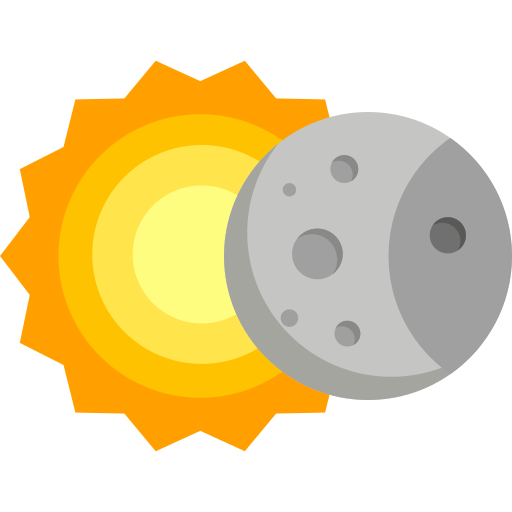
Eclipse
NOUN - Intermediate
When one celestial body moves into the shadow of another, like the moon blocking the sun during a solar eclipse.
Lunar eclipses are more common than solar eclipses and can be seen from anywhere on the night side of Earth.

Observatory
NOUN - Intermediate
A building designed to observe stars and planets using powerful telescopes.
Observatories are situated in remote areas to minimize light pollution.

Constellation
NOUN - Intermediate
A group of stars forming a pattern in the sky, like Orion.
There are 88 officially recognized constellations in modern astronomy.

Asteroid
NOUN - Basic
A celestial body made mostly of rock and metal, smaller than a planet, that orbits the Sun.
Most asteroids are located in the asteroid belt between Mars and Jupiter.

Dwarf Planet
NOUN - Intermediate
A celestial object that orbits the Sun, is smaller than a planet, and has not cleared its orbital region of debris.
In our solar system, there are many potential dwarf planets, but only five are officially recognized.
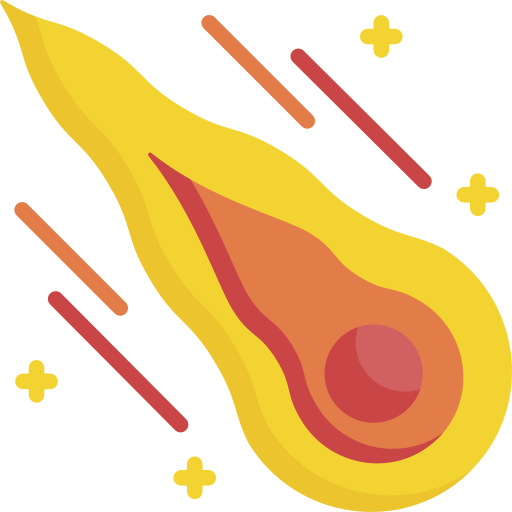
Comet
NOUN - Basic
A space object that is made of rock, dust, ice, and frozen gases that orbits the Sun.
The most famous comet is Halley's Comet, which returns to the inner solar system roughly every 76 years.
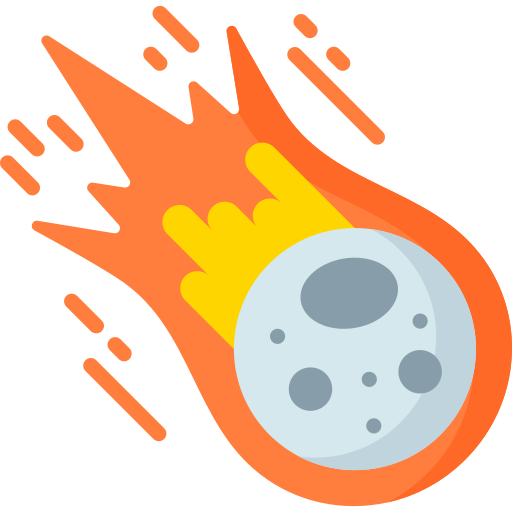
Meteor
NOUN - Basic
A streak of light we can see when a space rock enters the Earth's atmosphere and burns up.
As a meteor burns up, sometimes a fragment lands on Earth; this is called a meteorite.

Luminosity
NOUN - Advanced
The total amount of light or energy a star releases into space.
By studying a star's luminosity and temperature, astronomers can estimate its size.

Solar Flare
NOUN - Advanced
A sudden, intense burst of energy and radiation erupting from the Sun's surface.
Solar flares can disrupt radio communications and navigation systems on Earth.

Impact
NOUN - Basic
When a space object, like an asteroid, hits another, often resulting in changes or damage.
Asteroid impacts have led to the formation of craters on the Moon.

Crater
NOUN - Basic
A large bowl-shaped hole on the surface of a planet or moon, often formed by the impact of an asteroid.
Craters on the Moon, such as Tycho and Copernicus, are visible from Earth with a telescope.
Quiz
Practice your vocabulary with a free 10-Question Comprehension Quiz
Astronomy
Comprehension Quiz
Next Exercise:
The Universe Nouns & Quiz